SELBE Research Institute
An Evolutionary Computation System Design Concept for Developing Controlled Closed Ecosystems: An Intelligent Systems Approach to Foster Gravitational Ecosystem Research for Developing Sustainable Communities in Space and on Earth
An adjustably-autonomous intelligent systems approach for developing a connected network of Closed Ecosystems (CESs) is presented. It includes a design concept and preliminary design details for a Controlled Closed-Ecosystem Development System (CCEDS). An Orbiting Modular Artificial-Gravity Spacecraft (OMAGS) design concept is also presented, which enables the deployment of a closed ecosystem (CCEDS) in on-orbit in a spacecraft that generates artificial gravity and provides radiation protection to help the ecosystem thrive.The paper is divided into three sections: CESs, the CCEDS Design Concept, and Orbiting Fractional-Gravity Closed Ecosystems OMAGS design concept.
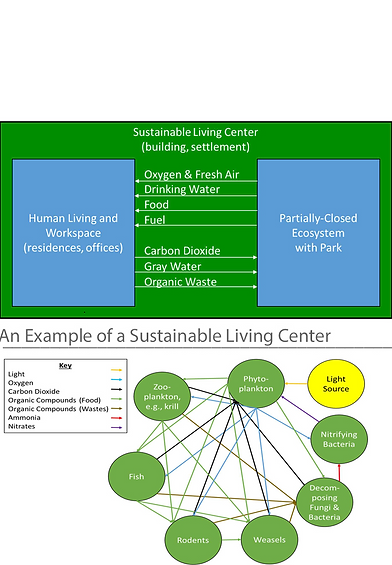
The first section briefly describes Closed EcoSystems (CESs), complex adaptive systems, biomes, microbial microbiomes, and their relevance for the study of astrobiology. This section also discusses initial efforts in the development of Closed Environment Life Support Systems (CELSSs) for sustainable communities in space and on Earth. This section concludes with a discussion of the bioregenerative life support system challenge of and the corresponding consequences due to the inverse relationship of the very small human biomass/non-human biomass ratio overall on the Earth with respect to the extremely large human biomass/non-human-biomass ratio found in cities and the International Space Station.
The second section describes the CCEDS design concept, which consists of a population of controlled colonies of CES Modules (CESMs), each an integrated CES, continually generating data for an intelligent system that operates the CESs and their CESMs. A variety of CESM types and their use are briefly described. The CCEDS intelligent system uses an evolutionary computation algorithm described in this section to develop and optimize these CESs to increase their viability duration and the size of the animals they support with the ultimate goal to support populations of humans, both on Earth and in space. The CCEDS architecture, its five control subsystems, and its five evolutionary computation levels are also discussed. The section concludes with a discussion of several CCEDS design strategies.
The third section summarizes the OMAGS design concept for a spacecraft with a payload consisting of CESs in an orbiting spacecraft centrifuge that operates for at least 5 years. The spacecraft concept is described including its 150cm-radius centrifuge with a 2 ton & 3,000 liter bioscience payload capacity for 24 CESMs. The centrifuge design has four physical levels for its CESMs, each level subject to a different fractional gravity level. This section presents the spacecraft benefits of being designed and operated such that the spacecraft and payload centrifuge wheel counter-rotate resulting in net zero angular momentum and zero gyroscopic forces. Artificial-gravity generation by centripetal acceleration is also discussed. This section concludes by showing the external specifications of the CESMs and their layout in the centrifuge, followed by discussing the multi-payload module rationale. In tandem, the CCEDS and OMAGS systems can be used to foster gravitational ecosystem research for developing sustainable communities in space and on Earth.
SELBE RI Comments
Closed-ecosystems are essential to sustainably thrive beyond Earth. All wastes that humans create can be transformed into raw materials for future use. Plants and animals have been doing this for billions of years. This is a primary area of research for SELBE.
NASA/TM 2018-56787, document 20190000114, Gregory A. Dorais, 2018.